
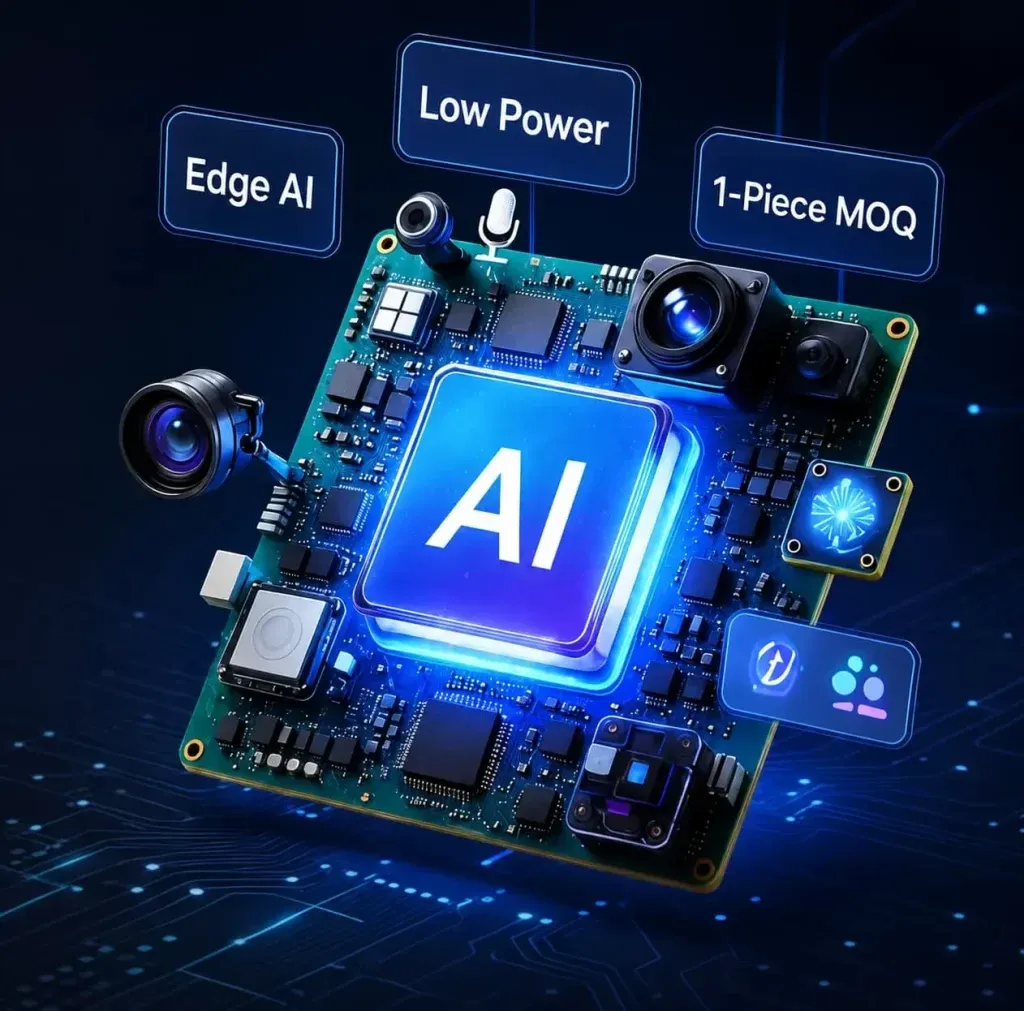
AI hardware is changing fast. In the past few years, most AI discussions have focused on cloud computing, GPUs, and model size. But in 2026, the conversation is moving closer to the device itself.
More products now need local AI processing, lower power consumption, faster response, and better data privacy. This shift is creating new challenges for hardware developers, electronics engineers, and PCBA manufacturing teams.
For companies building AI cameras, robotics systems, IoT devices, industrial controllers, smart sensors, or embedded AI products, hardware design is no longer just about choosing a powerful chip. Power design, PCB layout, thermal performance, component sourcing, testing, and manufacturability all matter from the beginning.
- Edge AI Chips Are Moving Into Real Products
Edge AI is no longer only used in advanced research projects. AI processors with dedicated NPUs are now appearing in smart cameras, industrial devices, robots, medical devices, consumer electronics, and IoT products.
Instead of sending all data to the cloud, these devices can process information locally. This can reduce latency, lower bandwidth costs, and improve privacy.
For hardware teams, this trend creates new design requirements. Edge AI chips often require a stable power supply, effective heat dissipation, high-speed memory, and careful PCB layout. If these details are not reviewed early, the product may work during prototype testing but become unstable during long-term operation or volume production.
For PCBA projects, this makes early DFM review and engineering communication especially important.
- Larger AI Models Are Being Deployed on Edge Devices
Developers are finding more ways to run advanced AI models on smaller devices. Techniques such as quantization, pruning, model compression, and distillation help reduce memory usage and power demand.
This means more edge devices can now support vision models, voice recognition, object detection, predictive maintenance, and some language-related AI functions.
However, running AI models locally also puts more pressure on the hardware. RAM size, flash capacity, memory bandwidth, processor temperature, and power stability can all affect real-world performance.
A model that performs well in software testing may still fail in the final product if the hardware design is not sufficiently stable. This is why AI hardware development needs close cooperation between software developers, electronics engineers, and PCBA manufacturers.
- Low-Power AI Design Is Becoming More Important
Not every AI product needs the highest computing power. Many applications need low power, long battery life, and stable always-on operation.
This is especially important for:
- Smart sensors
- Wearable devices
- Battery-powered IoT products
- Event-based cameras
- Industrial monitoring equipment
- Remote control and detection systems
Neuromorphic computing and other low-power AI architectures are gaining attention for their energy efficiency. These technologies are still developing, but the direction is clear: future AI hardware will compete not only on TOPS performance but also on performance per watt.
For PCBA design, low-power AI products need careful power management, component selection, sleep-mode design, and functional testing.
- Heterogeneous Computing Is Becoming the Standard
Modern AI hardware usually does not rely on a single processor. Many systems combine several processing units to handle different tasks.
A typical AI hardware system may include:
- CPU for system control
- GPU for parallel computing
- NPU for AI inference
- MCU for low-power control
- FPGA or DSP for special signal processing
This architecture improves performance, but it also makes the hardware more complex. Engineers need to consider power sequencing, signal integrity, EMI control, thermal design, firmware compatibility, and PCB layout from the early stage.
For manufacturers, this also means the BOM needs to be reviewed carefully. Some AI chips, memory devices, sensors, and power ICs may have long lead times or limited availability. A good alternative component plan can reduce production delays later.
- RISC-V and Open Hardware Are Creating More Options
RISC-V and open-source hardware platforms are becoming more attractive for embedded AI and custom hardware development.
For startups and engineering teams, RISC-V can offer more flexibility than traditional closed architectures. It allows teams to explore customized processors, AI accelerators, and application-specific designs.
But flexibility also brings new challenges. Before moving into production, teams need to check software support, supplier stability, long-term availability, testing tools, and manufacturing risk.
For PCBA manufacturing, this means that the engineering review should not only check the PCB files. The full production plan should include chip availability, programming method, test points, firmware loading, and final functional testing.
- Manufacturing Readiness Matters Earlier Than Before
AI hardware projects often start as fast prototypes. But a working prototype is not the same as a production-ready product.
Common problems appear when teams move from prototype to batch production:
- Components become unavailable
- Heat dissipation is not enough
- PCB layout needs adjustment
- Connectors or cables are not suitable
- The testing process is not clearly defined
- Assembly tolerance affects the final product
- Firmware loading and functional testing take longer than expected
These problems can increase cost and delay delivery.
That is why AI hardware teams should consider manufacturing requirements early. DFM review, BOM checking, component sourcing, SMT assembly planning, AOI inspection, X-ray inspection, and functional testing should be included in the project plan before mass production.
What This Means for AI Hardware Developers
In 2026, AI hardware development is becoming more cross-disciplinary. Developers cannot only focus on algorithms. Hardware engineers cannot focus only on the schematic. Manufacturing teams cannot wait for final Gerber files.
Successful AI hardware products need all three sides to work together:
Software defines the AI function.
Hardware supports stable performance.
Manufacturing turns the design into repeatable products.
For developers and hardware teams, the key questions are:
- Can the selected AI chip be sourced reliably?
- Is the PCB layout suitable for high-speed and high-power operation?
- Is the thermal design enough for long-term use?
- Are there alternative components for important ICs?
- Can the product be tested efficiently after assembly?
- Is the design ready for small-batch or volume production?
Answering these questions early can reduce risk and make the product easier to scale.
Conclusion
The main AI hardware trends in 2026 are clear: more edge computing, more local AI models, better energy efficiency, more heterogeneous architectures, and more flexible chip ecosystems.
But for real products, the most important challenge is not only choosing the newest AI processor. The real challenge is building a stable, manufacturable, and cost-effective hardware system.
For AI hardware developers, electronics companies, and product teams, early PCBA manufacturing planning can make a big difference.
PCBAEng supports AI hardware projects from prototype to production, including PCB assembly, component sourcing, DFM review, SMT assembly, testing support, and small-batch or volume manufacturing.