
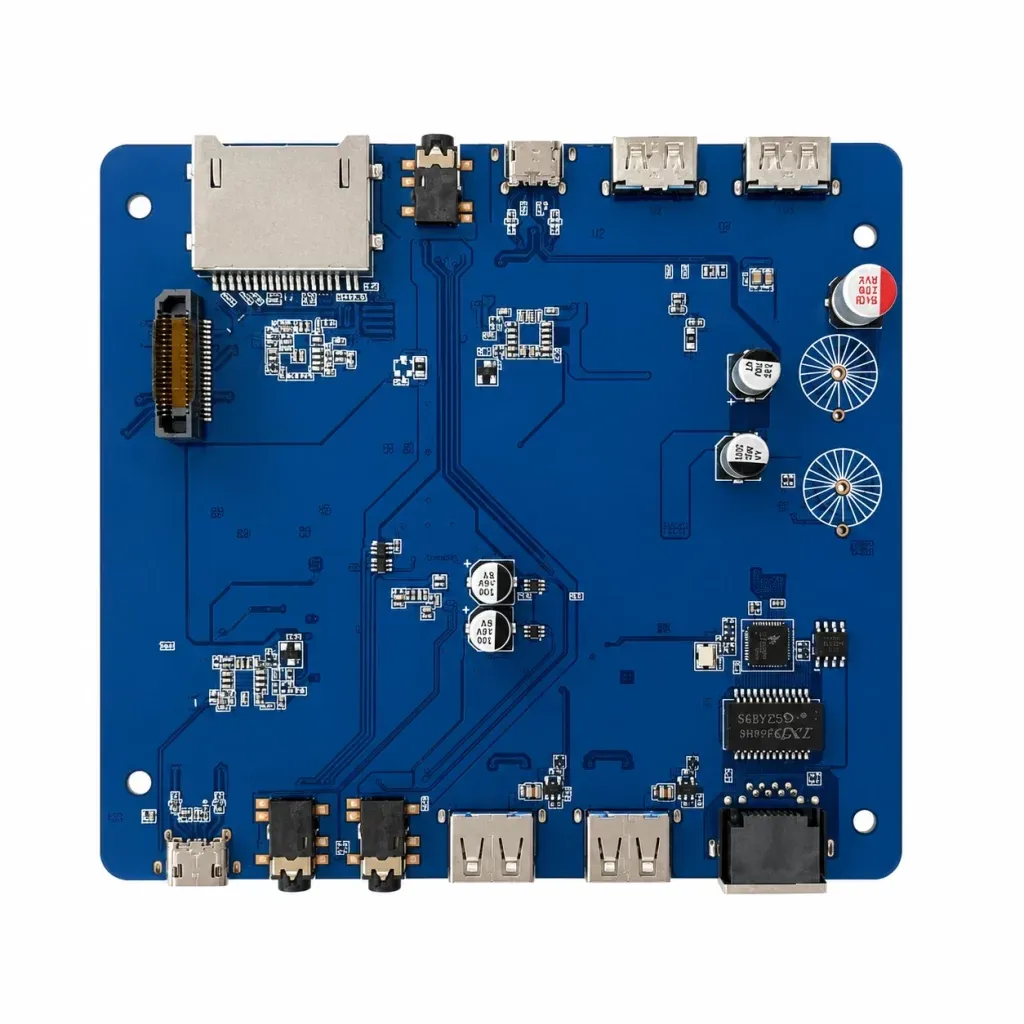
Choosing the right AI hardware platform is one of the most important decisions in an edge AI or embedded AI project. The selected platform will affect model performance, power consumption, thermal design, software development, PCB layout, component sourcing, testing, and final production cost.
For AI cameras, robotics systems, industrial inspection devices, smart sensors, medical devices, and IoT gateways, there is no single “best” AI hardware platform. The right choice depends on the application, performance target, power budget, software ecosystem, product size, and production plan.
This guide explains the main AI hardware platform options and the key factors hardware teams should review before moving from prototype to production.
1. High-Performance GPU Platforms
GPU platforms are often used when projects require high-performance parallel computing. They are popular in computer vision, robotics, edge servers, industrial AI systems, and early-stage AI product development.
The main advantage of GPU platforms is their mature software ecosystem. Many AI frameworks, model libraries, SDKs, and development tools already support GPU acceleration. This makes them useful for fast prototyping and testing complex models.
Common advantages include:
- Strong AI computing performance
- Mature development ecosystem
- Good support for computer vision and deep learning models
- Easier prototyping for engineering teams
- Wide documentation and community support
However, GPU platforms usually require more power and better heat dissipation. They may also increase BOM cost and make the final product larger or more expensive.
For PCBA design, GPU-based systems require careful power design, thermal planning, high-speed memory layout, and reliable connector design.
2. Dedicated Vision AI Chips
Dedicated vision AI chips are designed for image-based AI inference. They are often used in smart cameras, visual sensors, wearables, battery-powered devices, and compact industrial products.
These chips usually focus on low power consumption and efficient visual inference. For products that need always-on detection or simple AI vision tasks, they can be a good choice.
Advantages include:
- Low power consumption
- Compact hardware design
- Lower cost for specific use cases
- Good fit for camera-based AI products
- Suitable for battery-powered or fanless devices
The limitation is flexibility. Some vision AI chips only support specific model formats, operators, or toolchains. Model conversion may take extra time, and unsupported layers may reduce performance or require model changes.
Before selecting this type of chip, developers should confirm model compatibility, SDK maturity, camera interface support, memory requirements, and long-term chip availability.
3. SoC Platforms with Integrated NPU
Many modern embedded SoCs include an integrated NPU. These platforms are widely used in edge gateways, smart displays, video conferencing devices, industrial controllers, smart home hubs, and AI camera systems.
An SoC with CPU, GPU, NPU, video codec, memory controller, and peripheral interfaces can reduce board complexity and cost. This is attractive for products that need balanced performance rather than maximum computing power.
Advantages include:
- Good balance of performance, cost, and power
- Integrated NPU for AI inference
- Support for video encoding and decoding
- Smaller PCBA footprint
- Suitable for multimedia and edge AI devices
The challenge is software support. Some SoC platforms have limited documentation, fewer community resources, or more complex SDK requirements. NPU performance also depends heavily on whether the model operators are supported.
For hardware teams, the platform should be reviewed together with PCB layout, power rails, memory selection, thermal design, camera interfaces, and production testing requirements.
4. Cloud or Edge Inference Accelerators
Some AI hardware accelerators are designed for high-throughput inference in cloud, edge server, or local data center environments. These platforms can process many requests efficiently and are often used for recommendation systems, NLP, content moderation, video analytics, and large-scale AI inference.
Advantages include:
- High inference throughput
- Efficient processing for specific workloads
- Good fit for large-scale deployment
- Useful for edge servers and local AI gateways
- Can reduce load on general-purpose CPUs
However, these accelerators are usually optimized for specific workloads. They may not be suitable for every embedded product. They can also depend on stable network infrastructure, software integration, and specific deployment environments.
For product teams, this option is more suitable when the AI workload is centralized or semi-centralized, rather than running entirely on a small local device.
5. Key Factors Before Choosing a Platform
Before selecting an AI hardware platform, hardware teams should clearly define the project’s real requirements.
Important questions include:
- What model will run on the device?
- What inference speed or FPS is required?
- What latency is acceptable?
- What is the power budget?
- Is the product battery-powered or always connected?
- Is fanless operation required?
- What camera, sensor, display, or communication interfaces are needed?
- Is the software ecosystem mature enough?
- Are the main chips available for long-term supply?
- What is the target production quantity?
Spec sheets are useful, but they do not tell the full story. Real performance depends on memory bandwidth, software optimization, thermal design, power stability, and model compatibility.
A chip with high TOPS may not perform well if the NPU does not support the model or if thermal throttling occurs during long-term operation.
6. Prototype First, Then Plan for Production
For early development, it is usually better to start with a mature platform that has good documentation, development boards, SDK support, and community resources. This reduces engineering risk and helps the team verify the model and application faster.
For mass production, the requirements may change. The team may need a lower-cost SoC, a smaller PCBA, better power efficiency, customized connectors, or a more stable supply chain.
Before production, the platform should be reviewed from both engineering and manufacturing perspectives:
- BOM cost
- Component availability
- Alternative component options
- PCB layer count and layout difficulty
- Power supply design
- Thermal management
- Test points and programming method
- Functional testing process
- Enclosure and connector compatibility
- Certification requirements
This helps avoid the common problem in which a prototype works but the design becomes difficult or expensive to manufacture.
7. PCBA Design Considerations for AI Hardware
AI hardware platforms often include high-speed interfaces, dense components, and strict power requirements. This makes PCBA design more important.
Key PCBA considerations include:
- DDR memory layout
- PCIe or MIPI routing
- USB, Ethernet, or camera interface design
- Power integrity for CPU, GPU, NPU, and memory
- Thermal vias and heatsink mounting
- EMI control
- BGA assembly and X-ray inspection
- Programming and test access
- Long-term reliability testing
For AI products, hardware platform selection should not be separated from PCBA manufacturing planning. The earlier these issues are reviewed, the easier it is to move from prototype to batch production.
Conclusion
Choosing the right AI hardware platform is not only about selecting the chip with the highest computing power. A successful platform must match the real application, model requirements, power budget, software ecosystem, product size, cost target, and production plan.
GPU platforms are useful for high-performance development and complex AI workloads. Dedicated vision AI chips are suitable for low-power visual inference. SoCs with integrated NPUs offer a strong balance for many edge AI products. Inference accelerators are valuable for high-throughput cloud or edge server applications.
For product teams, the best approach is to test with real workloads, measure actual performance, and review manufacturability before production.
PCBAEng supports AI hardware projects from prototype to production, including PCB assembly, component sourcing, DFM review, SMT assembly, testing support, and small-batch or volume manufacturing.